
Affiliations Expand
- PMID: 40742789
- DOI: 10.23736/S0022-4707.25.16817-5
Abstract
Sports injuries are a significant concern for athletes at all levels of competition, ranging from acute traumas to chronic conditions. Prompt diagnosis and effective treatment are crucial for an athlete’s recovery and quality of life. Traditionally, sports injury diagnosis has relied on clinical assessments, patient history, and basic imaging techniques such as X-rays, ultrasound, and magnetic resonance imaging (MRI). However, recent technological advancements have revolutionized the field of sports medicine, offering more accurate diagnoses and targeted treatment strategies. High-resolution MRI and CT scans provide detailed images of deep tissue injuries, while advanced ultrasound technology enables on-field diagnostics. Wearable sensor devices and machine learning algorithms allow real-time monitoring of an athlete’s movements and physical loads, facilitating early intervention and injury risk prediction. Regenerative medicine, including stem cell therapy and tissue engineering, has emerged as a transformative approach to healing damaged tissues and reducing treatment time. Despite the challenges of high costs, lack of skilled personnel, and ethical considerations, the integration of artificial intelligence and machine learning into sports medicine holds immense potential for revolutionizing injury prevention and management. As these advancements continue to evolve, they are expected to extend athletes’ careers and enhance their overall quality of life. This review summarizes conventional methods to diagnose and manage injuries and provides insights into the recent advancements in the field of sports science and medicine. It also states future outlook on the diagnosis and treatment of sports injuries.
Similar articles
- Advancing Sports Cardiology: Integrating Artificial Intelligence with Wearable Devices for Cardiovascular Health Management.Zheng X, Liu Z, Liu J, Hu C, Du Y, Li J, Pan Z, Ding K.ACS Appl Mater Interfaces. 2025 Mar 26;17(12):17895-17920. doi: 10.1021/acsami.4c22895. Epub 2025 Mar 12.PMID: 40074735Review.
- American Medical Society for Sports Medicine position statement: concussion in sport.Harmon KG, Drezner JA, Gammons M, Guskiewicz KM, Halstead M, Herring SA, Kutcher JS, Pana A, Putukian M, Roberts WO.Br J Sports Med. 2013 Jan;47(1):15-26. doi: 10.1136/bjsports-2012-091941.PMID: 23243113Review.
- [Imaging of muscle injuries in sports medicine].Heiss R, Janka R, Uder M, Hotfiel T, Gast L, Nagel AM, Roemer FW.Radiologie (Heidelb). 2023 Apr;63(4):249-258. doi: 10.1007/s00117-023-01118-7. Epub 2023 Feb 16.PMID: 36797330Review.German.
- Is There a Role of Photoacoustic Imaging in Sports Medicine: Evidence Today.Ma C, Chadha AN, Wu C, Giannoudis PV, Guo JJ.Orthop Surg. 2025 Jun;17(6):1589-1603. doi: 10.1111/os.70031. Epub 2025 Mar 25.PMID: 40132986Free PMC article.Review.
- Imaging in sports medicine: an overview.Coris EE, Zwygart K, Fletcher M, Pescasio M.Sports Med Arthrosc Rev. 2009 Mar;17(1):2-12. doi: 10.1097/JSA.0b013e318195ffb0.PMID: 19204546Review.
- How Advanced Sports Medicine Is Transforming the Diagnosis and Treatment of Sports Injuries
How Advanced Sports Medicine Is Revolutionizing Injury Recovery for Athletes
Sports injuries are an unavoidable part of athletic competition, affecting everyone from recreational players to elite professionals. Whether it’s a sudden ligament tear, muscle strain, stress fracture, or chronic joint pain, early diagnosis and effective treatment can make the difference between a quick comeback and a career-threatening setback.
Thanks to rapid advancements in sports medicine, athletes today benefit from smarter diagnostics, personalized rehabilitation, and innovative treatments that were unimaginable just a decade ago. From high-resolution MRI and wearable sensors to artificial intelligence and regenerative medicine, the future of sports healthcare is becoming faster, more accurate, and increasingly preventive.
Why Early Diagnosis Matters
The first step toward successful recovery is identifying the injury correctly. Delayed or inaccurate diagnosis can lead to prolonged recovery, repeated injuries, and long-term damage.
Modern sports medicine focuses on:
Early detection of injuries
Precise diagnosis of soft tissue damage
Personalized rehabilitation plans
Prevention of recurring injuries
Safe return-to-play decisions
The goal is no longer just treating injuries—it is preventing them before they happen.
Advanced Imaging Is Changing Sports Injury Diagnosis
Traditional X-rays remain valuable for detecting fractures, but they cannot identify many soft tissue injuries. Today’s imaging technologies provide much greater detail.
High-Resolution MRI
Magnetic Resonance Imaging (MRI) has become one of the most important tools in sports medicine. It offers detailed images of:
Ligament tears
Muscle strains
Tendon injuries
Cartilage damage
Joint inflammation
High-resolution MRI helps doctors detect injuries at earlier stages, allowing treatment to begin before the condition worsens.
CT Scans
Computed Tomography (CT) scans provide exceptional detail for complex bone injuries and joint structures. They are particularly useful for diagnosing:
Stress fractures
Complex joint injuries
Bone abnormalities
Surgical planning
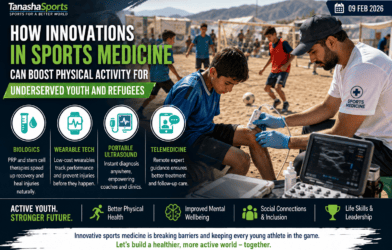
Portable Ultrasound Brings Diagnosis to the Sidelines
Modern ultrasound devices are no longer confined to hospitals.
Portable, high-resolution ultrasound allows sports physicians to evaluate injuries directly on the training ground or during competitions. It is especially useful for:
Muscle tears
Tendon injuries
Ligament sprains
Joint swelling
This rapid assessment helps medical teams make immediate treatment decisions without waiting for hospital imaging.
Wearable Technology Is Preventing Injuries Before They Happen
One of the biggest breakthroughs in sports science is the rise of wearable technology.
Smart devices now monitor an athlete’s body in real time by tracking:
Heart rate
Running mechanics
Joint movement
Training load
Fatigue levels
Recovery patterns
By identifying unusual movement patterns or excessive workload, coaches and medical teams can reduce injury risk before symptoms appear.
Benefits of Wearable Sensors
Technology
Purpose
GPS Trackers
Monitor distance and speed
Motion Sensors
Analyze movement mechanics
Heart Rate Monitors
Measure training intensity
Load Sensors
Detect overtraining risk
Recovery Trackers
Optimize rest periods
Artificial Intelligence Is Making Sports Medicine Smarter
Artificial Intelligence (AI) is transforming how injuries are diagnosed and managed.
Machine learning algorithms can analyze thousands of athlete data points to identify patterns that humans might miss. AI can help with:
Predicting injury risk
Monitoring rehabilitation progress
Detecting movement abnormalities
Personalizing training programs
Supporting return-to-play decisions
Rather than replacing doctors, AI acts as a powerful decision-support tool for sports medicine professionals.
Regenerative Medicine Is Accelerating Recovery
Instead of simply reducing pain, regenerative medicine focuses on repairing damaged tissues.
Stem Cell Therapy
Stem cell treatments are being explored for their potential to regenerate cartilage, tendons, and ligaments. Researchers believe these therapies could shorten recovery time for selected injuries while improving long-term joint health.
Tissue Engineering
Scientists are also developing bioengineered tissues that may help repair damaged muscles and cartilage more effectively than conventional treatments.
Although many regenerative therapies remain under active research, they represent one of the most exciting frontiers in sports medicine.
The Future of Personalized Athlete Care
The next generation of sports medicine will combine multiple technologies into one integrated system.
Imagine an athlete wearing smart sensors during training. The data is instantly analyzed by AI, abnormal movement is detected, portable ultrasound confirms a minor injury, and a personalized rehabilitation program is delivered through a mobile app—all within hours.
This connected approach could dramatically improve both injury prevention and recovery.
Challenges Still Facing Sports Medicine
Despite remarkable progress, several obstacles remain.
High Treatment Costs
Advanced imaging equipment, wearable devices, and regenerative therapies are often expensive, limiting access for amateur athletes and developing regions.
Shortage of Specialists
Many communities still lack trained sports medicine physicians, physiotherapists, and rehabilitation experts.
Ethical Considerations
As technologies such as stem cell therapy and AI become more common, healthcare providers must ensure treatments remain safe, evidence-based, and ethically responsible.
What the Future Holds
Sports medicine is moving beyond treating injuries after they occur. The future focuses on prediction, prevention, and personalized recovery.
Key trends expected to shape the next decade include:
AI-powered injury prediction
Smarter wearable devices
Portable diagnostic imaging
Regenerative tissue therapies
Personalized rehabilitation programs
Data-driven athlete performance monitoring
These innovations have the potential to extend athletic careers, reduce recovery time, and improve quality of life for athletes at every level.
Conclusion
Modern sports medicine is entering a new era where technology and healthcare work together to protect athletes before injuries become serious. High-resolution imaging, wearable sensors, artificial intelligence, and regenerative medicine are transforming the way sports injuries are diagnosed, treated, and prevented.
As these innovations become more accessible, athletes—from youth players to professionals—can expect faster recoveries, safer rehabilitation, and longer, healthier sporting careers.
Publication types
MeSH terms
- Artificial Intelligence
- Athletic Injuries* / diagnosis
- Athletic Injuries* / diagnostic imaging
- Athletic Injuries* / therapy
- Humans
- Machine Learning
- Magnetic Resonance Imaging
- Regenerative Medicine
- Sports Medicine* / methods
- Sports Medicine* / trends
- Tissue Engineering
- Tomography, X-Ray Computed
- Ultrasonography
- Wearable Electronic Devices
Related information
LinkOut – more resources
- Full Text Sources
- Medical