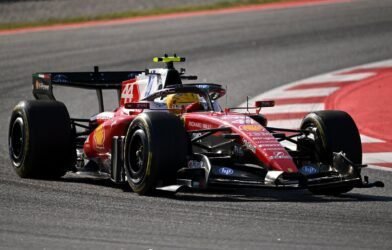

What Hamilton is changing for Canada
Hamilton has reportedly shifted away from his usual heavy simulator-led preparation and is instead focusing on a more track-centric, adaptive approach for Montreal.
The key elements of his revised method include:
1. Less reliance on simulator data
Hamilton has indicated that simulator running is not fully matching real-world behaviour of the Ferrari SF-26, creating correlation issues between virtual and track performance.
Because of that mismatch, he is choosing to trust on-track feedback more heavily rather than building his entire weekend setup around simulator expectations.
2. More emphasis on in-session learning
Instead of arriving with a fixed setup direction, Hamilton is prioritising:
- FP1 adaptation (especially important in Canada’s sprint weekend format)
- Rapid setup changes based on real grip levels
- Tyre behaviour learning over long runs
This is especially important at Circuit Gilles Villeneuve, where grip levels evolve quickly and walls punish even small misjudgements.
3. “Reset” mindset for a high-risk circuit
Montreal is one of F1’s most unpredictable tracks, with safety cars, kerb strikes, and strategy swings often deciding results.
Hamilton’s approach reflects:
- Reduced pre-conceived setup bias
- More reactive race-weekend decision making
- Greater focus on execution over experimentation
Why this matters specifically for Canada
The Canadian GP is uniquely difficult because:
- There is only one practice session before Sprint Qualifying
- Track evolution is extremely fast
- Braking zones are heavy and unforgiving
- The “Wall of Champions” punishes small errors instantly
So a flexible approach can sometimes be more valuable than a perfect simulated setup.
Bigger picture: Hamilton adapting in 2026
This shift also reflects a broader theme in Hamilton’s current Ferrari era—adapting to:
- A new car philosophy
- Different simulator correlation issues
- The demands of the 2026 technical regulations era
He has also recently called for stronger driver input in F1’s decision-making process, highlighting how modern F1 has become more complex and data-driven than ever.
Summary
Hamilton’s “different approach” for the Canadian GP is essentially about:
- trusting real track feedback more than simulation
- staying flexible with setup direction
- prioritising adaptability in a high-uncertainty Sprint weekend
It’s a calculated shift aimed at extracting maximum performance from a car-driver package that is still being fine-tuned.
Lewis Hamilton has tweaked his preparation for the Canadian Grand Prix, having struggled of late in Formula 1.
Aside from a successful weekend at Shanghai, Hamilton has underperformed relative to Ferrari team-mate Charles Leclerc so far in 2026, including last time out in Miami.
The Briton was 0.379s slower in sprint qualifying, then 0.176s down in the main session; he was 24 seconds away from Leclerc in the grand prix before the Monegasque spun, hit the wall and landed a penalty for corner-cutting – all of which occurred on the final lap.
As it happens, the Chinese Grand Prix was the only one Hamilton didn’t prepare for on the simulator; he said he would revert to this approach ahead of Canada as he felt the tool, instead of being helpful, was steering his car away from the ideal set-up, because of its correlation (or lack thereof) with track performance.
Hamilton described the SF-26’s behaviour on the Floridan track – especially early in the weekend – as “not very snappy into corners” and suffering from “massive understeer in mid-corner”, hence a shift being required.
“I’m going to have a different approach in the next race, because the way we’re preparing at the moment is not helping,” Hamilton, who’s lying fifth in the drivers’ championship, said following the Miami round.
“We go on [the simulator] and then it gets to the track and the car feels different when it gets to the track.”

Lewis Hamilton, Ferrari
Photo by: Ryan Pierse / Getty Images
Asked to expand on how he wasn’t ‘preparing properly’, the seven-time world champion explained: “What I mean by it is that I spend time on the simulator. I don’t like simulators in general. I was in the simulator every week on the build-up to this race, working on correlation constantly. You go on it, you prepare for the track, you drive it and you get the car set up to a certain place, and then you come to the track and that set-up doesn’t work.
“On the sprint weekend, for example, you’ve only got Practice 1. You don’t really want to veer off from your set-up too far, like with a big suspension change. So you stay with it and then you make a change going into qualifying and you’ve only got six laps to get on top of it.
“So in an ideal world I should have started where Charles was at the beginning of the weekend, and I think we would have just had a stronger weekend from there.
“So, I’m not going to go on the simulator right now on the next race. I’ll still go and hold meetings at the factory and stuff. I’m just going to back away from it for a little bit and see. When we went to China I had the best weekend without sim.”
Hamilton did clarify that he was happy with the SF-26 besides the set-up problem, with this year’s smaller, nimbler cars suiting his preference better.
Regardless, Hamilton expects the Canadian GP to be another tricky race for Ferrari, due to the successive 600m, 550m, 1.2km and 650m straights, with the Scuderia down on power relative to Mercedes.
“We’re losing three to four tenths just on straightline speed, so that’s there and it’s going to be there until we fix it,” Hamilton pointed out. “We need to see if we can cut some drag before the next race.”
<https://ukpdf.com/