It is fair to say that the 2026 Formula 1 season has so far generated more controversy off the track than on it, with the usual endless debates surrounding the regulations – and before that, Mercedes’ engine compression ratio.
On track, however, matters have remained relatively calm. There have been a handful of incidents and collisions here and there, but nothing sufficiently contentious to place stewards under heavy scrutiny. For the time being, they have largely escaped criticism.
Looking solely at the Sunday races, the opening three grands prix of the year were surprisingly uneventful in the stewards’ room.
In Australia, four incidents were investigated without resulting in a single penalty. In China, only one race incident was formally investigated – the collision between Esteban Ocon and Franco Colapinto. In Japan, in an extremely rare occurrence, no investigations were launched during the race, not even for the clash between Colapinto and Oliver Bearman.
Miami, the first race following April’s unexpectedly long break, saw an increase in contentious situations but still relatively few penalties. Ultimately, Canada became the first event genuinely marked by significant steward intervention.
One constant nevertheless emerges from every stewarding decision so far this season: not a single penalty point has been issued on a superlicence in 2026. Last year, sporting penalties had been accompanied by penalty points on five occasions over the opening five grands prix. In 2024, that figure stood at eight.
It is well known that, following the debates sparked amongst drivers by Pierre Gasly’s situation at the end of 2022 and Bearman’s position late last season, the FIA and the stewards have sought to take a softer approach to penalties that were sometimes viewed as excessive for infractions not considered genuinely dangerous.
The intention itself is understandable. It avoids placing drivers at risk of suspension for accumulating “minor” mistakes, while attempting to restore the system’s original purpose: punishing genuinely serious offences and discouraging repeat behaviour.
Much more lenient stewards

Esteban Ocon received no penalty points for the collision with Franco Colapinto in China.
Photo by: James Sutton / Formula 1 / Formula Motorsport Ltd Getty Images
Still, after the Canadian Grand Prix, one has to wonder whether the pendulum has now swung too far in the opposite direction. The case of Isack Hadjar is perhaps the most revealing.
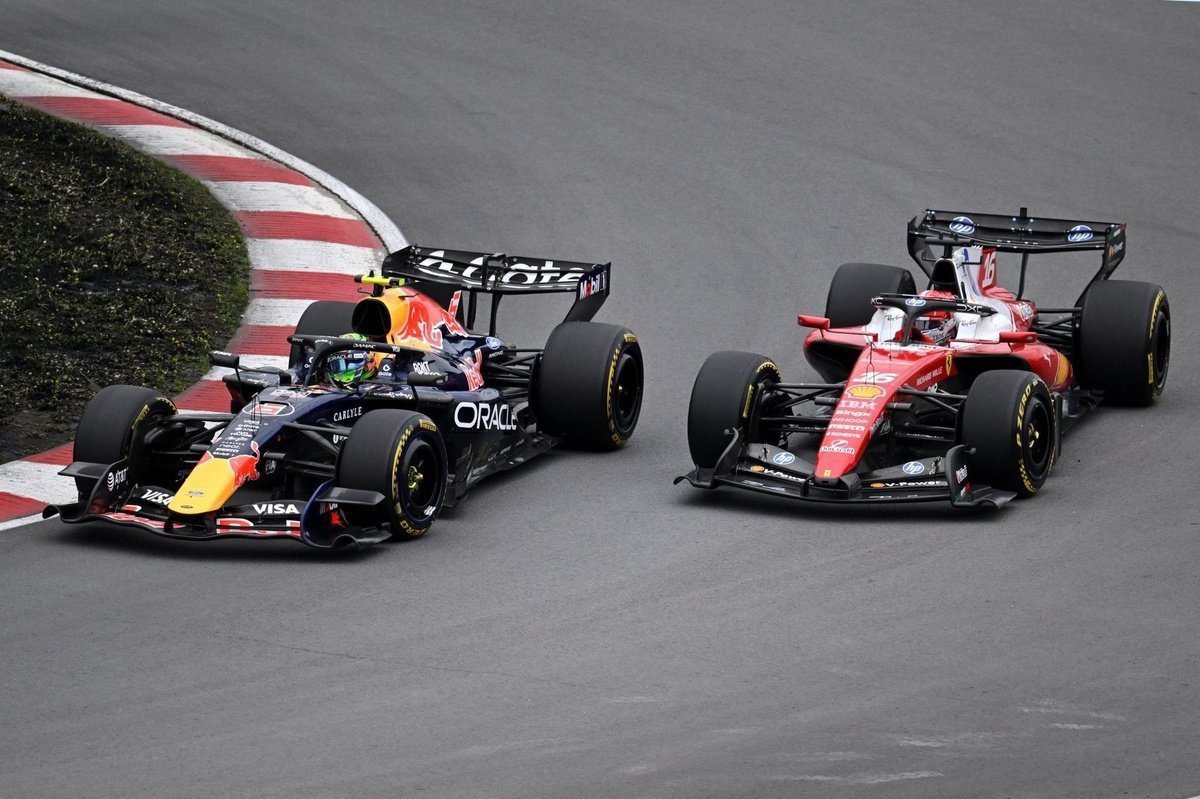
The Red Bull driver was penalised twice during the Canadian GP. The first came for his defence against Charles Leclerc, during which he changed direction multiple times. He received a 10-second penalty.
The infringement was clear, potentially dangerous, yet the stewards imposed no penalty points. One may debate the decision, but it is consistent with what has been seen this year regarding offences punished by 10-second penalties.
During the same race, Oscar Piastri – penalised for causing contact with Alex Albon – also received a 10-second penalty without any penalty points. Going back to China, the same applied to Ocon following his collision with Colapinto: 10 seconds, but no points.
That already reflects a far more lenient interpretation of penalty points. In each case, responsibility was obvious, the offence unmistakable, and while of course no one would suggest deliberate intent, the errors themselves appeared sufficiently serious (sometimes with real consequences) to warrant more than a simple sporting penalty.
Last season, multiple defensive moves typically resulted in one penalty point, while responsibility for avoidable collisions generally resulted in two.
Yet it is Hadjar’s second penalty in Montreal that raises even greater questions.
The Frenchman committed what is traditionally regarded as a particularly serious offence: failing to “make a significant reduction in speed” under double yellow flags. Even if the wording alone does not fully convey the gravity of the infringement, the scale of the punishment certainly does – a 10-second stop-and-go penalty, one of the harshest sanctions available in modern Formula 1, short of disqualification.
And yet, once again, no penalty points were issued.
What changed in 2026?

The drivers banded together to push for more lenient penalties.
Photo by: Sam Bagnall / Sutton Images Getty Images
According to information gathered by Autosport, this shift in the application of penalty points stems from winter discussions between the FIA and the drivers. The drivers reportedly pushed for a softer system in which points would only be issued for behaviour deemed deliberate or reckless.
That philosophical shift is clearly reflected in the amendments made between 2025 and 2026 to the guidelines outlining penalties for both stewards and the public.
Compared to 2025, the document now explicitly states from the outset that, in a number of cases – those where the corresponding penalty points are marked with an asterisk – the figure shown “denotes the guideline MAXIMUM” (yes, in capital letters), and that “any number of points from 0 to that number could be imposed”.
Fundamentally, that clarification does not drastically alter what was already common practice last year. However, the fact that the document now explicitly states from the beginning that issuing no penalty points at all is entirely acceptable is highly revealing.
Take the failure to respect double yellow flags during a race. The wording itself has not changed: the stewards are still instructed to impose a 10-second stop-and-go penalty, while retaining the option to issue up to three penalty points – a figure marked, in both 2025 and 2026, by the same asterisk.
The same applies to multiple changes of direction in defence: sporting penalties can range from five seconds to a drive-through penalty, while stewards may issue up to three penalty points.
The more significant changes concern the offence that historically attracted penalty points more than any other: causing a collision.
The document now specifies that “penalty points for causing [a collision] should be adjusted based on the severity of the incident caused”. It confirms what several stewarding decisions already made clear last season – that consequences are explicitly taken into account.
The shift becomes even clearer in the section describing “causing a collision with no immediate and obvious sporting consequence”. A note states in plain terms: “a ‘collision’ [in] which very minor contract e.g. a touch or ‘kiss’ may result in no penalty”. In such cases, the maximum number of penalty points available has been reduced to zero, whereas last year stewards could impose up to three.
Conversely, for collisions involving “apparent deliberate or reckless intent”, the prescribed four penalty points remain unchanged, theoretically without any possibility of reduction.
A points-based system stripped of its substance?

Kevin Magnussen is the only driver to have been suspended under the points system since 2014.
Photo by: Sam Bloxham / Motorsport Images
The intention, as set out in the documentation, to impose fewer penalty points and, overall, to reduce the number of penalties, is therefore clear. It is a defensible objective in principle, but the Hadjar case in Canada raises difficult questions.
Reducing sanctions in order to focus on genuinely serious offences is one thing. But if ignoring double yellow flags no longer qualifies as a serious infringement, then the range of offences likely to trigger penalty points has become extremely narrow.
In a proof by contradiction, one could reasonably ask whether Max Verstappen would even have received penalty points in 2026 for the collision with George Russell at the 2025 Spanish Grand Prix. At the time, the stewards stopped short of describing the move as “deliberate” or “reckless” – despite many considering it obviously intentional.
From there, the question becomes simple: what is the purpose of maintaining a penalty points system in Formula 1 if stewards are increasingly reluctant to issue points even in situations far removed from the “minor” incidents that sparked debate in recent years?
This is not a case of crossing the pit exit line, ignoring blue flags for too long, or even forcing another driver off track during a hard-fought battle. It concerns a breach of one of motorsport’s most fundamental safety rules: disregarding one of the clearest warning signals in racing.
The penalty points system may never have functioned perfectly – or even ideally – but today it risks being stripped of almost all meaning if it is reserved only for extreme, and therefore exceedingly rare, cases, without any genuine consideration of repeat offences.
Whether the decision to adopt a more lenient approach is right or wrong is not for us to judge. That belongs to the governing body and the stakeholders involved, and there are perfectly valid arguments in its favour. But one question remains entirely legitimate: is it still relevant to maintain the system conceived in 2014 in its current form? There is room for doubt.
We want to hear from you!
Let us know what you would like to see from us in the future.
– The Autosport.com Team